
The traditional coaching whiteboard has two problems. First, it lives in the changing room: not on your phone, not in your assistant's inbox, not in your club's shared drive. Second, anything drawn on it disappears the next time someone needs to write the starting XI.
Digital drill diagrams solve both problems. This guide explains what makes a good drill diagram and how to build one efficiently.
What a Good Drill Diagram Shows
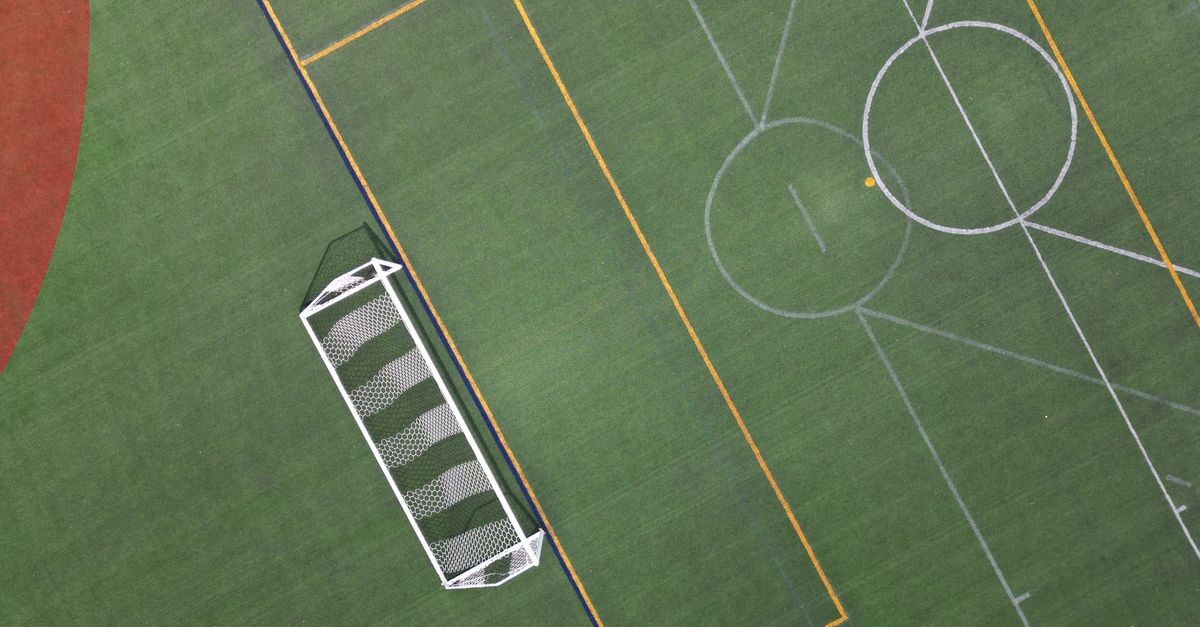 A top-down pitch view makes player positions and movement paths immediately readable.
A drill diagram is not art. It is a communication tool. It needs to answer four questions:
- Where do players start? Position matters, too many coaches draw diagrams where it is unclear whether the player starts inside or outside the cone.
- Where do they move? Arrows should show movement paths, not vague intentions. Solid arrows for runs with the ball, dashed for off-ball movement is a widely understood convention.
- What is the shape of the space? Cone gates, zone boundaries, and penalty areas should be visible and to scale.
- What is the sequence? If the drill has phases (pass, move, receive, shoot), the diagram should show the order.
Anything beyond this is noise. Player numbers can help in complex patterns; they hurt in simple ones.
Choosing Your Format
 Diagrams that coaches can explain in ten seconds are the ones players actually follow.
There are three common formats for football drill diagrams:
Paper and pen. Fast to produce, impossible to edit, impossible to share. Fine for personal notes, useless for staff communication.
Whiteboard photos. Even harder to read than paper: low contrast, angle distortion, wet ink smears. The recipients can rarely tell a player icon from a cone.
Digital pitch canvas. Takes longer to set up the first time but the result is clear, editable, shareable, and printable. Every subsequent session using the same drill takes seconds.
How to Build a Drill Diagram Digitally
A good football drill diagram tool gives you a pitch as the base layer, player icons you can drag and position, cone or zone markers for the setup, and arrows to show movement. The icons should be distinct enough that players can read the diagram quickly without a legend.
On Clubroom's pitch canvas, you add players by clicking the toolbar and placing them on the pitch. Cones and zones are separate elements. Arrows can be coloured (white for player runs, yellow for ball movement, red for pressing paths) so the diagram communicates at a glance.
The key feature is that you can set a step order on each arrow. That means the diagram shows phase one (player runs to receive), then phase two (ball is played), then phase three (second movement). This is far clearer than trying to number every arrow by hand.
Tips for Readable Diagrams
Use colours sparingly. Two colours (one for attackers, one for defenders) plus a ball path colour is the maximum most people can read quickly. Adding more colours forces your audience to stop and decode.
Keep the pitch area relevant. A drill that happens in a 20x20 area does not need the full pitch. Zoom in. The larger your shape relative to the pitch, the more readable the positions are.
Label only what is ambiguous. If you have four players in a square, you do not need to label them 1–4. If you have eight players with different roles, labels help.
Share it before training. A diagram sent the night before lets players arrive having already visualised the shape. The setup time halves because players know where to go.
From Diagram to Session
A single drill diagram is useful. A session full of diagrams, linked together in order, with durations and coaching notes, is a session plan. That is the step from disorganised coaching to structured development.